Worms at War: How Invasive Earthworm Species Are Dismantling Forest Soil Systems That Native Species Spent Millennia Building
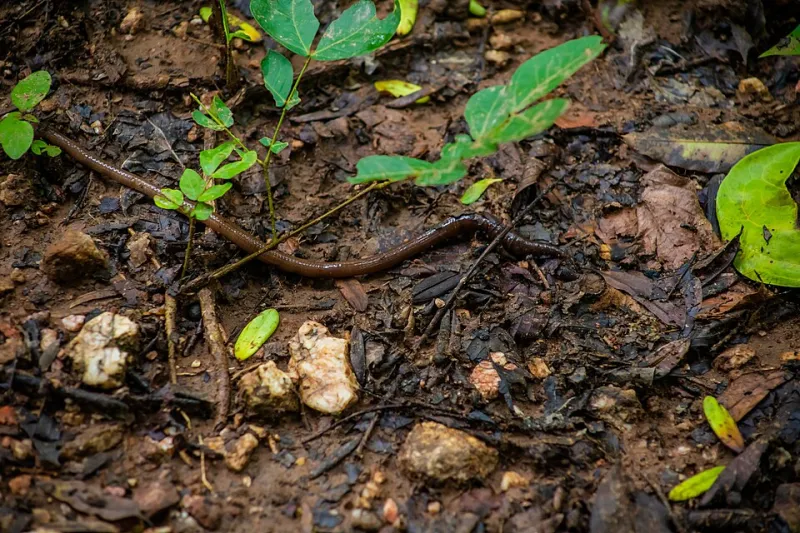
Photo: Tiisu Sharif, CC BY-SA 4.0, via Wikimedia Commons
There is a widespread assumption, even among ecologically literate Americans, that earthworms are uniformly beneficial—that wherever they are found, they are improving the soil. This assumption is wrong, and the consequences of its persistence are playing out across millions of acres of North American forest.
The story begins with glaciation. When the Laurentide Ice Sheet retreated from northern North America roughly ten thousand years ago, it left behind a landscape essentially devoid of earthworms. The native earthworm fauna of the northern United States and Canada had been eliminated, and the forest ecosystems that subsequently developed did so in the absence of significant earthworm activity. These forests evolved thick, biologically active organic layers—the duff, the leaf litter, the spongy mat of partially decomposed material known to ecologists as the O horizon—that serve as habitat for specialized invertebrates, fungi, and plant root systems, and as a significant reservoir of stored carbon.
The earthworms that most Americans encounter in their gardens are not native to these ecosystems. They are European species—primarily Lumbricus terrestris, Aporrectodea caliginosa, and related taxa—introduced through horticultural soil, ship ballast, and bait bucket releases over centuries of European settlement. These species have been altering northern forest soils for generations, but their spread has been relatively gradual, limited by dispersal biology and climate constraints.
The Arrival of a More Disruptive Invader
In the past two decades, a new and considerably more aggressive group of invasive earthworms has established itself across the eastern United States and is spreading rapidly. Asian jumping worms—comprising several species in the genus Amynthas and related genera, collectively sometimes called snake worms or Alabama jumpers—are native to East Asia and were likely introduced through the horticultural trade. Unlike European invasives, jumping worms are parthenogenetic, capable of reproducing without mating, and they produce cocoons that survive winter conditions and are easily transported in mulch, compost, and soil amendments.
The ecological signature of jumping worm invasion is unmistakable. These species consume organic material at extraordinary rates, processing the O horizon and converting it into a loose, granular castings layer with a texture frequently compared to coffee grounds. The resulting soil surface is dramatically altered: the spongy organic mat that native wildflowers, salamanders, ground-nesting birds, and a wide array of invertebrates depend on is replaced by a structurally unstable, nutrient-depleted, and hydrologically altered substrate.
Research from the University of Wisconsin–Madison and the Morton Arboretum has documented significant reductions in native plant diversity, earthworm-sensitive invertebrate communities, and soil carbon content in jumping worm-invaded forest plots compared to uninvaded reference sites. In some cases, native spring ephemeral wildflowers—including trilliums, trout lilies, and bloodroot—have declined sharply or disappeared entirely from invaded areas, unable to establish in the restructured soil environment.
What Native Earthworm Communities Actually Do
To understand the damage invasive earthworms cause, it is essential to understand what functional native communities provide in the regions where they remain intact—primarily the southern and western United States, where glacial extirpation did not occur.
Native earthworm species in the southern Appalachians, the Ozarks, and the Pacific Coast ranges are integral to soil aggregation processes that determine water infiltration, aeration, and resistance to compaction and erosion. They mix organic material into the mineral soil at rates and depths calibrated by their evolutionary history in those specific systems, creating the stable macroaggregates that physically protect soil carbon from microbial decomposition. Their burrow networks establish preferential flow paths for water and roots that persist long after individual worms die.
Native species also participate in complex relationships with soil fungi, bacteria, and plant roots that are disrupted when invasive earthworms alter the physical and chemical environment. Mycorrhizal networks—the fungal systems that connect tree root systems and facilitate nutrient transfer across forest communities—are sensitive to the soil disturbance that invasive earthworm activity generates. Several studies have documented reduced mycorrhizal colonization of tree roots in heavily invaded soils, with potential implications for tree growth, drought tolerance, and seedling establishment.
From a climate perspective, the carbon storage implications are significant. Forest soils represent one of the largest terrestrial carbon pools in North America, and the O horizon that invasive earthworms consume is a disproportionately important component of that pool. Research modeling the carbon consequences of jumping worm invasion across the northern hardwood forest region suggests that widespread invasion could represent a meaningful source of atmospheric carbon release—a factor that has received almost no attention in national carbon accounting frameworks.
Management Pathways: What Science Currently Offers
Honestly confronting the earthworm invasion problem requires acknowledging a difficult reality: there is currently no cost-effective method for eliminating established invasive earthworm populations from forest soils. The biology of these organisms—their soil-dwelling life history, their cocoon persistence, and in the case of jumping worms, their parthenogenetic reproduction—makes eradication from invaded sites essentially impossible with available tools.
What science does offer is a set of management strategies aimed at slowing spread, protecting high-priority sites, and restoring some degree of ecological function in invaded areas. Prevention remains the most effective intervention. Strict protocols governing the movement of soil, mulch, and nursery stock—including mandatory heat treatment of commercial mulch products to destroy earthworm cocoons—can significantly reduce the rate of new introductions. Several midwestern states have implemented or are considering regulations on the sale of jumping worms as fishing bait, a major vector of spread.
At the site level, research groups are investigating the use of saponin-based soil treatments derived from mustard seed meal, which irritate earthworms and cause them to surface where they can be collected. While this approach has shown promise in small-scale trials, scaling it to forest application remains technically and logistically challenging. Biological control research is in early stages, with no approved agents currently available.
Native plant restoration following earthworm invasion requires modified approaches that account for the altered soil environment. Practitioners working in invaded sites have found that raised-bed planting techniques, the addition of wood chip mulch to partially restore organic layer depth, and the selection of native species with broader soil tolerance ranges can partially compensate for the loss of O horizon structure.
A Policy Framework That Soil Science Demands
American forest policy has not yet integrated earthworm invasion into its risk assessment and management frameworks in any systematic way. The USDA Forest Service's invasive species programs focus primarily on plants, insects, and pathogens; soil fauna receive minimal attention despite the evidence that their alteration produces consequences of comparable ecological magnitude.
Addressing this gap would require, at minimum, the inclusion of invasive earthworm risk in environmental review processes for soil-disturbing activities in sensitive forest ecosystems, expanded federal investment in jumping worm monitoring and early detection networks, and the development of model regulations for soil and mulch movement that states could adopt consistently. More ambitiously, it would require integrating earthworm-driven carbon dynamics into the soil carbon accounting methodologies used to evaluate forests as climate mitigation assets.
The science of soil ecology has made clear that what happens beneath the forest floor is not secondary to what happens above it. The organisms that build and maintain soil structure are as ecologically consequential as the trees they support. Recognizing invasive earthworms as a first-order threat to forest ecosystem integrity—and building policy frameworks that reflect that recognition—is a necessary step toward managing America's forests for long-term resilience rather than surface-level appearances.