Fire as Medicine: Reconstructing the Longleaf Pine Ecosystem Through the Science of Controlled Burning
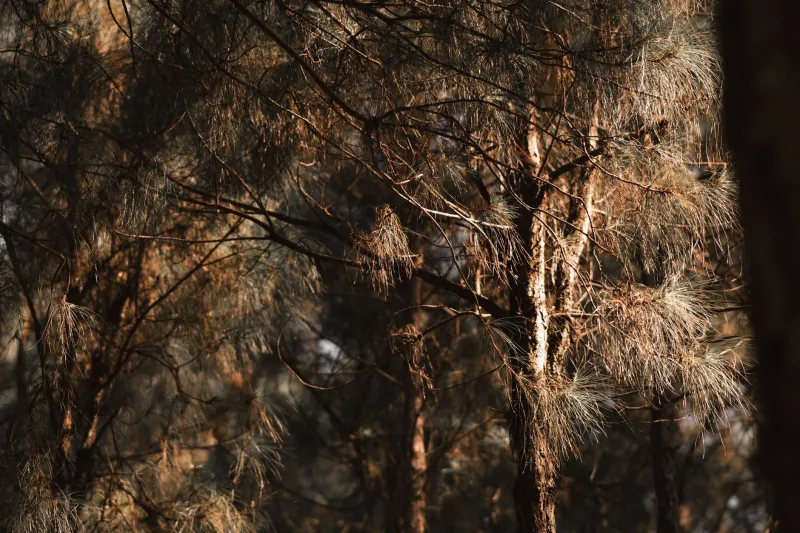
There is a particular quality of light in a mature longleaf pine savanna that those who study it tend to describe with unusual consistency: open, slanted, reaching the forest floor in a way that feels almost deliberate. It is the light of a system shaped by fire—an ecosystem whose biological logic was written in smoke and ash over thousands of years, then very nearly erased in fewer than a hundred.
The longleaf pine (Pinus palustris) once organized the ecology of the American Southeast with a comprehensiveness that few forest types anywhere in the temperate world can match. From the sandhills of North Carolina to the coastal plains of East Texas, this single species and the fire-dependent community it anchored supported more plant species per square meter than almost any terrestrial ecosystem in North America, rivaling the species density of tropical systems. Today, less than 3 percent of the original extent remains in anything approaching ecological function. Understanding how this collapse happened—and what science says about reversing it—is one of the more urgent and instructive stories in American conservation.
A System Built on Disturbance
Longleaf pine ecology cannot be understood without understanding fire, because fire was not a disturbance to this system—it was its operating condition. Lightning-ignited burns swept through the open savannas of the Southeast every two to five years under natural conditions, consuming accumulated grasses and wiregrass understory without killing the fire-adapted pines whose thick bark and resinous crowns had evolved precisely for this environment. These frequent, low-intensity fires maintained the open canopy structure that allowed sunlight to reach the ground, suppressed hardwood competitors that would otherwise shade out the grass layer, and created the complex mosaic of microhabitats—from gopher tortoise burrows to pitcher plant bogs—that made the longleaf system so extraordinarily diverse.
The red-cockaded woodpecker, which excavates cavities exclusively in living longleaf pines with red heart fungus, became one of the system's most studied indicator species. The gopher tortoise, whose burrows provide shelter for more than 350 other species, is another. Bachman's sparrow, the indigo snake, the flatwoods salamander—the roster of longleaf-dependent species reads like an inventory of the Southeast's most imperiled wildlife. Their decline is inseparable from the decline of the fire regime that maintained their habitat.
How a Continent Was Cleared
The destruction of the longleaf system unfolded in overlapping waves. The first was industrial timber extraction in the late nineteenth and early twentieth centuries, which removed the mature pine at a pace that left virtually no old-growth longleaf standing outside a handful of preserved sites. The second wave was agricultural conversion and naval stores production—the harvesting of pine resin for turpentine and tar that stripped the remaining trees of their bark and left the landscape exhausted.
The third wave, arguably the most ecologically consequential, was fire suppression. As federal and state forestry agencies institutionalized the suppression of wildfire throughout the mid-twentieth century, the fuel-consuming burns that had maintained the longleaf understory ceased. Hardwoods—oaks, sweetgums, water tupelos—moved in from the edges. The wiregrass understory, unable to survive in shade, disappeared. The open savanna became closed forest, and the species communities that depended on the savanna structure collapsed with it.
Research by ecologists including William Platt, Robert Peet, and their collaborators has documented this successional process in quantitative detail. Studies of remnant longleaf sites show that fire exclusion periods as short as fifteen years can produce hardwood encroachment sufficient to fundamentally alter understory light conditions and plant community composition. Recovery from that encroachment, once entrenched, requires aggressive intervention.
What Prescribed Fire Actually Does
The science of prescribed burning in longleaf systems has matured considerably over the past three decades, moving from a tool used largely on intuition to one guided by detailed research on burn timing, intensity, frequency, and ecological outcomes. The findings are consistent and compelling.
Wiregrass (Aristida stricta and related species), the keystone understory plant of the longleaf system, requires growing-season fire—burns conducted in spring and early summer—to flower and set seed effectively. Dormant-season burns, which are easier to conduct from a safety standpoint, maintain the system but do not stimulate wiregrass reproduction with the same efficacy. Research at sites including Eglin Air Force Base in Florida and Tall Timbers Research Station in the Florida panhandle has demonstrated that growing-season burn regimes produce measurably higher understory plant diversity and better recruitment of longleaf pine seedlings than dormant-season regimes alone.
The thermal ecology of longleaf pine itself is equally well studied. Longleaf seedlings spend their first several years in a grass stage, producing a dense cluster of needles at ground level that protects the terminal bud from fire. This adaptation—unique among American pines—allows seedlings to survive repeated burns that would kill other species, effectively eliminating competition during the establishment phase. Restoration practitioners have learned that prescribed burns conducted at the right intervals can mimic this natural selection pressure, giving planted longleaf seedlings the competitive advantage they evolved to exploit.
Projects Showing What Recovery Looks Like
The longleaf restoration effort is now one of the most active large-scale ecological recovery programs in the American Southeast, coordinated through the America's Longleaf Restoration Initiative and involving federal agencies, state governments, private landowners, and tribal nations. The numbers are significant: more than 4.7 million acres are currently under active longleaf management, with a stated goal of reaching 8 million acres by 2025.
At Fort Bragg—now Fort Liberty—in North Carolina, intensive prescribed fire management over three decades has produced one of the largest and most ecologically functional red-cockaded woodpecker populations outside of a dedicated wildlife refuge. The Apalachicola National Forest in Florida manages more than half a million acres under a longleaf restoration framework, with fire return intervals approaching the natural frequency documented in pre-colonial fire scar records. Private landowners in Georgia and Alabama, supported by Natural Resources Conservation Service cost-share programs, have enrolled hundreds of thousands of acres in longleaf restoration, motivated partly by the hunting and wildlife values that intact longleaf systems produce.
These projects share a common finding: when fire is restored at appropriate frequency and timing, the biological community responds. Not immediately, and not without setbacks—invasive species, drought, and market pressures complicate every restoration trajectory—but the system's underlying resilience asserts itself when given the conditions it requires.
Reframing the Relationship Between Fire and Forest
The longleaf story carries implications that extend well beyond the Southeast. It demonstrates, with unusual clarity, that fire suppression is not a neutral act. In fire-dependent ecosystems, preventing burns does not preserve the forest—it transforms it into something the resident species cannot inhabit. The ecological cost of that transformation is paid slowly, in the form of biodiversity loss and habitat degradation, until the debt becomes visible in the form of endangered species listings and collapsed wildlife populations.
For American forest policy, which remains anchored in a fire-suppression paradigm despite decades of contrary scientific evidence, the longleaf pine ecosystem is both a cautionary history and a working proof of concept. Prescribed fire, applied with scientific rigor and institutional commitment, can rebuild what suppression destroyed. The question is whether the policy frameworks governing America's forests will evolve quickly enough to make that rebuilding possible at the scale the science demands.