Standing Still, Serving Life: The Ecological Science of Deadwood and What It Means for America's Forest Future
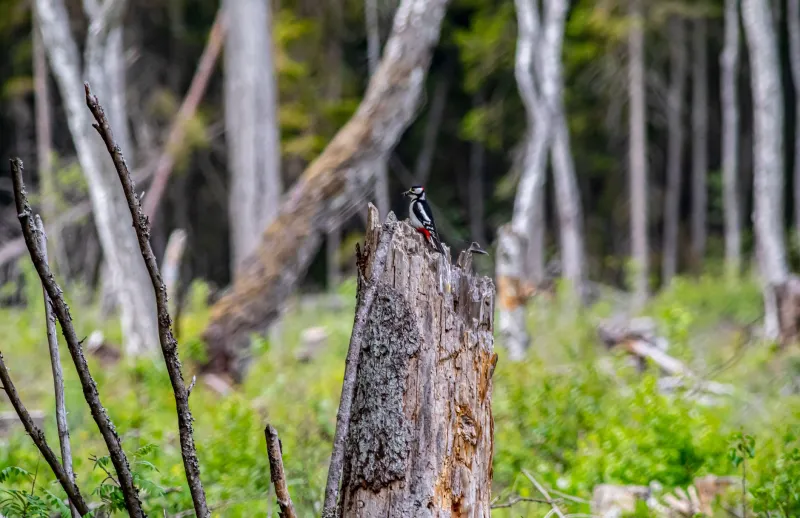
There is a particular kind of irony embedded in the history of American forest management. For much of the twentieth century, the removal of dead and dying trees was considered not merely acceptable practice but responsible stewardship—a form of tidying that reduced fire risk, eliminated insect breeding habitat, and projected the visual order that timber companies and federal agencies alike associated with a well-managed stand. The snag, that skeletal silhouette of a standing dead tree, was a problem to be solved.
Science has since arrived at a sharply different conclusion.
Research accumulated over the past three decades now characterizes deadwood—encompassing both standing dead trees and fallen logs in various stages of decomposition—as one of the most ecologically productive structural features in North American forests. The organisms that depend on it, the nutrient cycles it drives, and the biodiversity it anchors have elevated snags and coarse woody debris from nuisances to necessities. And yet forest management policy, shaped by legacy assumptions and constrained by genuine fire management pressures, has been slow to follow.
What Happens Inside a Dead Tree
The transformation of a living tree into an ecological community begins almost immediately after mortality. Within the first year, wood-boring beetles—particularly longhorned beetles and bark beetles—colonize the cambium layer, excavating galleries that serve simultaneously as feeding tunnels and brood chambers. These initial excavators are not merely destructive; they are architects. Their tunnels introduce oxygen, fungal spores, and moisture into wood that would otherwise remain sealed, initiating the decomposition cascade upon which much of the forest's secondary productivity depends.
Primary and secondary cavity-nesting birds follow. Pileated woodpeckers, arguably the most ecologically significant cavity excavators in eastern and Pacific Northwest forests, require large-diameter snags with sufficient heartwood decay to support their excavation—conditions that typically take decades to develop in standing dead trees. Their abandoned cavities are subsequently colonized by secondary nesters including flying squirrels, small owls, wood ducks, and numerous bat species, several of which are listed under the federal Endangered Species Act.
Estimates from Forest Service research suggest that in the Pacific Northwest alone, more than 100 vertebrate species depend on snags and coarse woody debris at some stage of their life cycle. In the hardwood forests of the Appalachians and the Upper Midwest, that number, while lower, still encompasses dozens of species with limited alternative habitat options.
The Soil Beneath the Log
Fallen logs tell a parallel story. As coarse woody debris progresses through decomposition stages—a process that can span 50 to 200 years depending on species, climate, and microbial community composition—it performs functions that living trees cannot replicate. Decaying logs serve as nurse substrates for tree seedling establishment in many conifer-dominated systems, particularly in the Pacific Northwest, where hemlock and Sitka spruce regeneration on nurse logs is so consistent that it has become a defining feature of old-growth forest structure.
Beyond seedling establishment, decomposing wood is a significant carbon reservoir. Research published in the last decade has revised upward the estimated contribution of coarse woody debris to forest carbon budgets, with some studies suggesting that deadwood accounts for between 8 and 20 percent of total forest carbon storage in mature temperate stands. In an era when forests are being actively reconsidered as carbon management tools, the ecological accounting of deadwood has direct policy implications.
Nitrogen cycling is another critical function. Certain wood-decay fungi and associated bacterial communities fix atmospheric nitrogen within decomposing logs, contributing to soil fertility in ways that are decoupled from conventional nutrient pathways. This is particularly consequential in stands recovering from disturbance, where soil nitrogen availability often constrains regeneration rates.
The Fire Management Tension
Acknowledging the ecological value of deadwood does not dissolve the legitimate concerns surrounding it in fire-prone landscapes. In the western United States, where decades of fire suppression have allowed fuel loads to accumulate to historically anomalous levels, large-diameter snags and downed logs represent real ignition and fire spread risk. The tension between deadwood retention and fire hazard reduction is not a manufactured controversy—it is a genuine management dilemma with life-safety dimensions.
However, researchers and practitioners have increasingly argued that the framing of deadwood as uniformly dangerous oversimplifies a complex relationship. Fire behavior is principally driven by fine fuels—grasses, shrubs, and small-diameter woody material—rather than large-diameter deadwood, which burns slowly and incompletely even under high-intensity fire conditions. Some ecologists have suggested that post-fire salvage logging, which removes snags created by wildfire, may actually increase fine fuel loads by opening the canopy and stimulating understory brush growth, potentially elevating fire risk in subsequent years rather than reducing it.
The Forest Service's own research arm has produced findings consistent with this interpretation, though translating that research into modified salvage policy has proven politically difficult in regions where timber interests retain significant influence over federal land management decisions.
Retention Forestry and the Emerging Policy Framework
The most promising institutional response to the deadwood science has emerged under the broad framework of retention forestry—a harvesting philosophy that prescribes the deliberate retention of biological legacies, including snags, large-diameter logs, and veteran trees, during timber operations. Originating in Pacific Northwest old-growth research in the 1990s and subsequently elaborated by researchers at institutions including Oregon State University and the University of Washington, retention forestry has gained traction in Forest Service planning documents and in the voluntary certification standards administered by the Forest Stewardship Council.
Federal forest plans developed or revised in the past decade have increasingly incorporated snag density targets—typically expressed as a minimum number of snags per acre above a specified diameter threshold—as measurable management objectives. The 2012 Planning Rule for National Forest System lands explicitly identifies wildlife habitat connectivity and structural diversity, including deadwood components, as planning priorities.
State-level forest practice rules have been slower to follow, particularly in states where private industrial timber operations are subject to weaker regulatory frameworks than federal lands. Oregon and Washington have incorporated some snag retention requirements into their forest practice acts, but minimum standards remain contested, and enforcement capacity is uneven.
A Reckoning with What We Removed
Perhaps the most sobering dimension of the deadwood science is what it implies about landscapes already heavily managed. Across vast portions of the eastern United States, a century of active snag removal, salvage logging, and fire suppression followed by aggressive fuel reduction has produced forests structurally impoverished in deadwood relative to historical baselines. Restoring those structural conditions requires not merely changing future practice but actively accelerating the creation of deadwood features—through techniques including girdling, prescribed fire, and the deliberate retention of dying trees—in stands where natural processes have been interrupted.
This is restoration work measured in decades and centuries, not project cycles. It demands institutional patience that government agencies and private landowners alike have historically struggled to maintain. But the science is unambiguous about what is at stake: forest ecosystems that lack deadwood are not merely aesthetically incomplete. They are functionally diminished, supporting fewer species, cycling nutrients less efficiently, and storing less carbon than their structural complexity would otherwise permit.
The dead tree standing at the edge of a managed stand is not a failure of stewardship. It is, the evidence now compels us to acknowledge, one of its highest expressions.