Underground Accounting: Why Mycorrhizal Science Is Exposing a Critical Blind Spot in Forest Carbon Policy
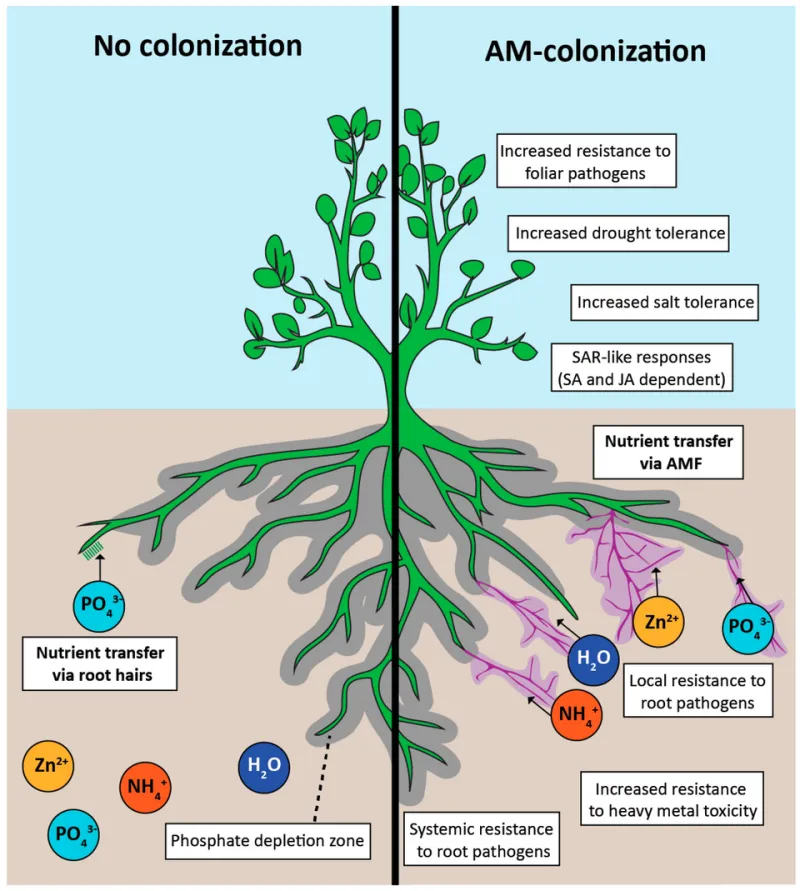
Photo: Catherine N. Jacott, Jeremy D. Murray and Christopher J. Ridout, CC BY-SA 4.0, via Wikimedia Commons
For every tree standing in an American forest, there exists a hidden partner—an elaborate web of fungal filaments threading through the soil, brokering nutrient exchanges, sequestering carbon, and quietly determining whether that tree survives drought, pathogen pressure, or the slow grind of climate disruption. Mycorrhizal fungi are not a peripheral detail of forest ecology. Increasingly, the science suggests they are its operating system. Yet the policy frameworks governing forest carbon accounting treat the soil beneath our feet as little more than a passive reservoir—a container rather than an actor.
That assumption is now under sustained scientific challenge, and the implications for carbon markets, forest management, and climate policy are substantial.
What Mycorrhizal Networks Actually Do
The term "mycorrhiza" derives from the Greek words for fungus and root, and the relationship the word describes is ancient—predating land plants by hundreds of millions of years. Today, an estimated 90 percent of terrestrial plant species engage in some form of mycorrhizal symbiosis. In temperate and boreal forests across the United States, two major guilds dominate: arbuscular mycorrhizal (AM) fungi, which penetrate root cells directly, and ectomycorrhizal (EM) fungi, which form a dense sheath around root tips without breaching the cell wall.
Both types perform a fundamental service. In exchange for photosynthetically derived carbon sugars—representing anywhere from 10 to 30 percent of a tree's total carbon output—mycorrhizal fungi extend the effective reach of the root system by orders of magnitude. Their hyphal threads, far finer than any root hair, access pores in the soil matrix that roots cannot penetrate, unlocking phosphorus, nitrogen, and micronutrients that would otherwise remain biologically unavailable.
But nutrient transfer is only the beginning. Research published over the past decade has established that mycorrhizal networks are active participants in carbon cycling in ways that standard soil carbon models have failed to capture. Fungal biomass itself represents a significant carbon pool. Hyphal turnover deposits organic compounds into the soil at rates that rival leaf litter inputs in some forest types. And critically, EM fungi in particular produce biochemically recalcitrant compounds—including melanins and long-chain lipids—that resist decomposition and contribute disproportionately to the formation of stable, mineral-associated soil organic matter.
The Measurement Problem
Here lies the crux of the policy failure. Conventional soil carbon measurement protocols—those underpinning voluntary carbon markets, federal forest management guidelines, and international climate reporting frameworks—were not designed with fungal biology in mind. They measure bulk soil organic carbon at defined depth intervals, often relying on loss-on-ignition or combustion techniques that cannot distinguish between carbon fractions with vastly different stability profiles or biological origins.
A 2023 analysis in Nature Geoscience estimated that mycorrhizal fungi globally sequester between 3 and 9 billion metric tons of carbon annually through hyphal production alone—a figure comparable to roughly 36 percent of global fossil fuel emissions in a given year. That carbon is largely invisible to current accounting systems. When a forest is logged, converted, or degraded, the mycorrhizal network collapses rapidly—often within weeks. The carbon it held, and the carbon stabilization processes it sustained, disappear with it. But because these losses were never counted in the first place, they register nowhere in carbon balance sheets.
This creates a dangerous asymmetry. Forest carbon projects that claim credits for protecting standing trees may be substantially understating the actual carbon value of intact fungal networks. Conversely, reforestation projects that plant trees into degraded soils lacking functional mycorrhizal communities may be dramatically overstating their sequestration potential—because without the fungal infrastructure, young trees cannot perform at the carbon uptake rates the models assume.
Implications for Carbon Credit Integrity
The voluntary carbon market in the United States has expanded rapidly, with forest-based offsets representing a significant share of traded credits. Yet the scientific basis for the sequestration values assigned to these credits remains, by the assessment of many researchers, dangerously incomplete. If mycorrhizal-mediated carbon represents a substantial and unmeasured fraction of forest carbon storage, then the credit values being bought and sold on the market are not merely imprecise—they may be systematically biased toward undervaluation of intact ecosystems and overvaluation of managed or replanted ones.
This matters for corporate net-zero commitments, regulatory offset programs, and any policy instrument that relies on forest carbon as a climate mitigation tool. A carbon credit system that ignores fungal biology is not simply incomplete. It may be actively misdirecting investment away from the forest conditions that generate the most durable carbon storage and toward management regimes that look productive above ground while quietly dismantling the biological infrastructure below.
Toward a Fungal-Literate Forest Policy
Addressing this blind spot will require movement on several fronts simultaneously. On the scientific side, researchers at institutions including the USDA Forest Service's Northern Research Station, the University of Michigan, and Colorado State University are developing new methodologies for quantifying fungal biomass carbon using phospholipid fatty acid markers, isotopic tracing, and high-throughput DNA sequencing. These approaches are not yet standardized, but the trajectory of the field is clear.
On the policy side, carbon accounting bodies—including the American Carbon Registry and Verra's Verified Carbon Standard—should be pressed to convene working groups specifically charged with integrating mycorrhizal science into forest carbon protocols. This is not a marginal technical adjustment. It represents a foundational revision of how we understand what forests do and what their protection is worth.
Forest management guidance, particularly on federal lands managed by the Forest Service and Bureau of Land Management, should also incorporate mycorrhizal health as an explicit management objective. Soil disturbance from heavy equipment, fungicide applications in replanting programs, and the introduction of non-native plant species that associate with different fungal guilds all carry costs that current management frameworks do not account for.
The Science Is Ahead of the Policy
This is a familiar condition in environmental governance—research outpacing regulatory frameworks by years or decades while ecosystems bear the cost of the lag. What distinguishes the mycorrhizal case is the scale of the potential miscalculation. We are not talking about a minor refinement to carbon models. We are talking about a biological process operating across every forested acre in the country, performing ecological services of climate significance, and receiving essentially no formal recognition in the policy instruments designed to protect it.
The fungi do not wait for policy to catch up. They continue their work in the dark—building, cycling, stabilizing—whether or not we choose to account for them. The question is whether American forest science and policy will develop the sophistication to recognize what has always been there, and to protect it before the accounting errors compound into irreversible ecological debt.