Reading the Air Through the Bark: Why Lichens Belong in Forest and Clean-Air Planning
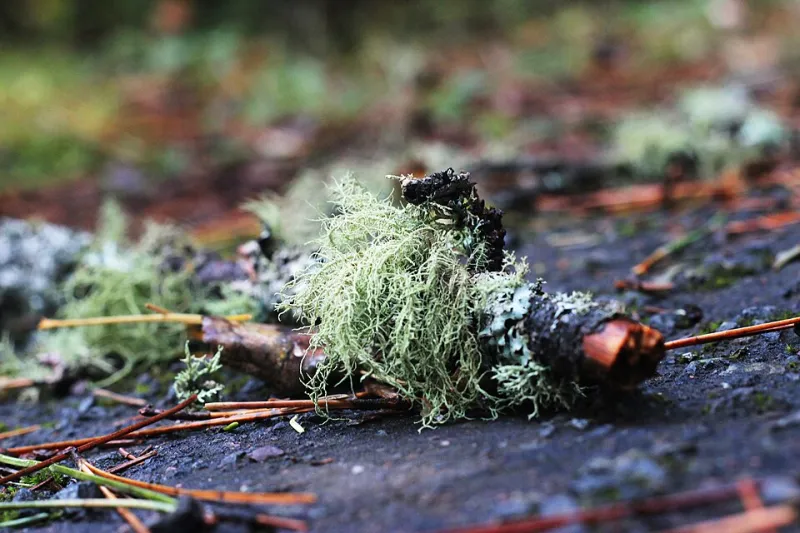
Photo: USFWS Midwest Region from United States, CC BY 2.0, via Wikimedia Commons
Lichens are easy to overlook. They crust fence posts, drape branches, and paint granite outcrops in colors that seem decorative rather than diagnostic. But lichens are not mere ornament. They are among the most responsive biological monitors in the forest, and they are telling us things about nitrogen deposition, sulfur pollution, and climate stress that our instruments and our institutions are not fully listening to.
This is an argument for a modest but consequential change in American environmental governance: lichens should be integrated more systematically into forest planning and air-quality policy. Not as a symbolic nod to biodiversity, but as a practical monitoring tool that can complement sensors, models, and regulatory networks.
A Sensor We Already Have
A lichen is not a single organism but a symbiosis, usually between a fungus and an alga or cyanobacterium. The fungus provides structure; the photosynthetic partner provides sugars. Because lichens lack roots and absorb nutrients and water directly from the atmosphere, they are exposed to airborne pollutants in a way that rooted plants are not. They also lack a waxy cuticle, which makes them unusually permeable.
That permeability is both a vulnerability and a scientific asset. Many lichens are sensitive to sulfur dioxide, which damaged lichen communities across the industrial Northeast and Midwest in the twentieth century. As sulfur emissions declined under the Clean Air Act, some lichen species recovered, offering a biological record of regulatory success. Nitrogen is a more complicated story. Some lichens thrive on nitrogen enrichment and become more abundant; others decline. The shift in community composition is itself a signal, a kind of ledger written on bark and stone.
What Lichens Measure
Lichen biomonitoring is not a single method. It includes community surveys, which record species presence and abundance; elemental analysis, which measures nitrogen and sulfur concentrations in lichen tissue; and physiological or morphological indicators that respond to stress. The U.S. Forest Service has supported lichen research through its Forest Inventory and Analysis program, and the National Park Service has used lichen communities to track air-quality effects in parks. State agencies, universities, and citizen-science groups have added local and regional datasets.
The strength of lichens is that they integrate multiple stressors over time. A sensor reports a concentration at a moment; a lichen community records the accumulated effect of deposition, drought, heat, and disturbance. That makes lichens especially useful for identifying areas where nitrogen deposition is changing forest conditions in ways that are not yet visible in the overstory. They can also help establish critical loads, the deposition thresholds below which ecosystems are protected from harm.
From Citizen Science to Critical Loads
There is already a base to build on. Lichen surveys have been used in the Pacific Northwest, the Northeast, the upper Midwest, and the Rocky Mountain West. Citizen-science programs have engaged volunteers in mapping lichen communities, and agency scientists have developed indicators that link lichen data to air-quality standards. But the data are uneven. Methods differ, plots are not always revisited, and the results are not consistently connected to management decisions.
The policy gap is not a lack of scientific credibility. It is a lack of institutional integration. State forest action plans often mention air quality as a stressor but do not include lichen monitoring as a routine indicator. Air-quality agencies rely on regulatory monitors that measure concentrations, not ecological effects. Forest plans may include lichen species in biodiversity inventories but rarely use them to evaluate deposition trends. The result is a fragmented system in which lichens are studied but not routinely used.
The Case for Integration
Integrating lichens into forest and air-quality planning would not require a new regulatory apparatus. It would require better use of existing programs. Forest inventories could add lichen indicators to a subset of permanent plots. State forest plans could identify lichen-based thresholds for nitrogen deposition. Air-quality agencies could use lichen data as evidence in critical-load assessments. Citizen-science programs could be standardized so that volunteer-collected data are comparable across regions.
There is also a climate dimension. Lichens respond to changes in moisture, temperature, and disturbance regimes. As forests experience more drought, wildfire, and pest outbreaks, lichen communities can serve as early indicators of stress. They are not a substitute for climate models or tree inventories, but they add a layer of biological evidence that is inexpensive relative to many monitoring systems.
A Modest Proposal for 2026
In 2026, the case for lichen biomonitoring is stronger than the policy uptake suggests. We recommend three steps. First, state forest action plans should include lichen community indicators in their air-quality and biodiversity sections, with clear links to management thresholds. Second, federal agencies should fund a coordinated lichen monitoring network that builds on existing plots and standardizes methods. Third, environmental agencies should use lichen data in critical-load and deposition assessments, not merely as supporting anecdote but as quantitative evidence.
Lichens will not solve the nitrogen problem or the climate crisis. They will, however, tell us where the damage is accumulating and whether our policies are working. In a forest policy landscape that often waits for trees to die before acting, that is a form of intelligence worth using.